
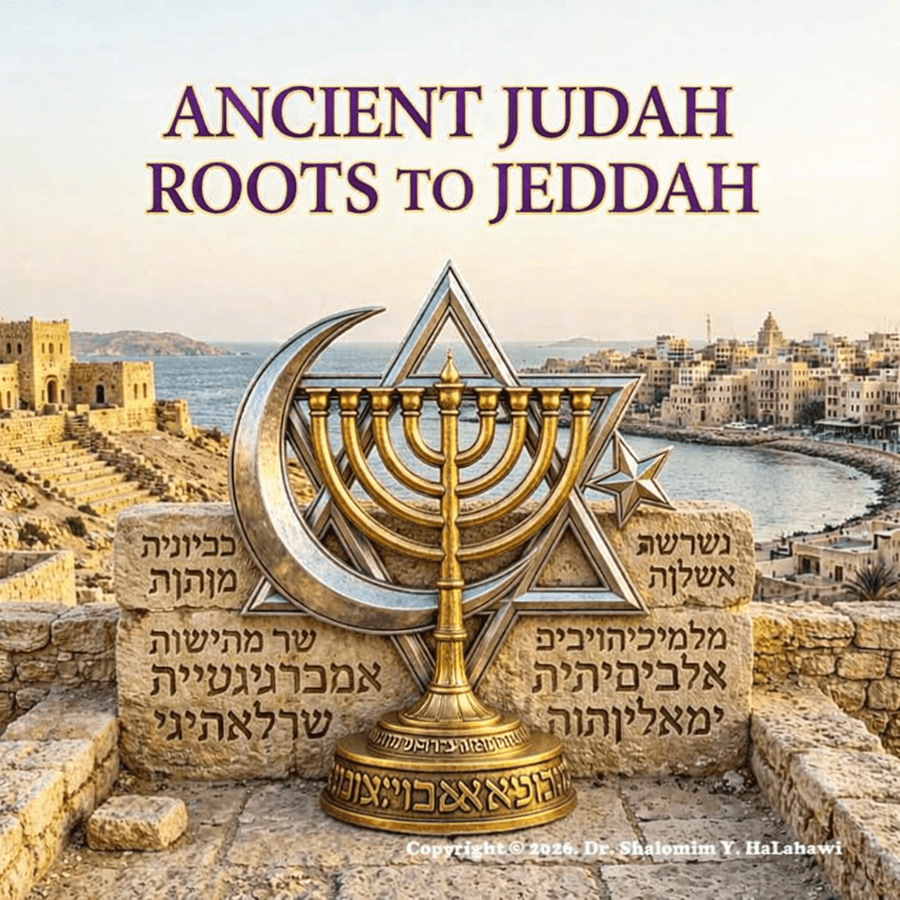
By Dr. Rabbi-Cohen Shalomim Yahoshua HaLahawi MD(I), OMD, PhD, PsyD, DFM, DPH, DACBN
Mizrahi-Ethiopian Jewish International Rabbinical Council
Ha’ Yisrayli Torah Brith Yahad, Inc.
Copyright©2026. All Rights Reserved
Jeddah, what Western education doesn’t teach
Why do Western “white” revisionists continue to ignore the obvious Middle Eastern Elephant in the Room, as it relates to Jeddah?
As an Ethnic Mt. Carmelite Mizrahi Jew, I find Western biblical, theological, and historical knowledge to be amongst THE WORST IN THE WORLD….. If people can’t even get the fact that GOD is a Babylonian Deity that has nothing to do with Yahwah in the Tenakh, then what else can’t they get right?
What about the fact that the Wailing Wall is not a remnant of the Temple of Solomon, but is in fact remnants of the Temple of Herod, built in a different location than the ancient Temple of Solomon, which was completely destroyed by fire during the time of Ezra and Nehemiah. Herod, an Idumean Judean, later built this Palace as a replacement.
Or the fact that ancient Yahudah was much further south than presented in today’s Biblical fiction
Jeddah, in Saudi Arabia, historically proves exactly that fact(not to mention there are scholarly books in the Middle East about biblical lands related to Israel and Judah, being much further south…
Jeddah’s Historical Connection to the Ancient Land of Yahudah(Latinized to Judah & also connected to the even more ancient Yadava and properly called Yahwdah).
Jeddah’s link to the ancient Land of Judah is rooted in both biblical geography and the historical continuity of Israelite presence in the region.
Biblical and historical context
The Land of Judah was the southern kingdom & enemy/rival of ancient Israel, centered on Jerusalem and including cities like Bethlehem, Hebron, and Beersheba Bible Hub+1(cities and a capital that pre-exilic Yisraelites DID NOT recognize, except the tribes of Judah, Benjamin, and their Canaanite priesthood of Zadokites who replaced and rivaled Levitical/Lahawite Priests).
In the pre-Islamic period, the northern part of the Hejaz (where Jeddah is located) was sometimes described by early Muslim historians as a dependency of the pre-exilic Kingdom of Yahudah.
Some scholars, such as Butrus al-Bustani, documented that Judahites established a sovereign state in northern Hejaz. This area was part of or closely associated with the Judahite & latern Iudean/Judean(a mixed multitude) political sphere before the rise of Islam.
Note: Yahudean/Iudean/Judean does not=Israelite. “Judean” was a nationality for citizens of Yudea(Iudea), which is NOT the Kingdom of Yahudah, a failed Kingdom that was wiped out by the Babylonians and never replaced, ending the evil of King David and his Mamzer son King Solomon’s brutal, non-Israelite recognized Kingdom. As a Lahawite Priest, I am speaking according to the views of the Northern Kingdom of Israel, the actual Legitimate Kingdom of the Torah peoples.
Just as Hebrew(Eberites/Ibrim, descendants of the Harappan Civilization led by Yadavas) is not a language but a larger ethnic group with subtribes consisting of all the descendants of Eber & all descendants of Abraham, including Israelites, Ishmaelites/Arabs, Idumeans(Edomites, twin peoples of Israelites), and all of the children of Keturah including Midianites, and those who named Africa after themselves(also note: this does not mean all Africans are Hebrews, they just wear a colonized name after Ophran and Ifran overthrew Libya, the ancient Capital of the entire pre-African Continent, and renamed the continent after themselves, and later established tribal kingdoms of West Africa via Igbo peoples. Julius Africanus did NOT name Africa, he was named after Africa. The Complete Works of Josephus documents the whole origin of the name Africa….), so also Judean is a nationality-political entity, like being an American/US Citizen. All Americans are not US citizens, and all US citizens are not of the same race, culture, religion, tribe, ethnic origins, or political persuasions. Even the religious term Judaism, used today, is misleading, as it should accurately be called Judeanism, and even then, its sub-category should define it as Idumeanism, as Idumeans founded Rabbinical Judaism, not Israelites(even though there were Israelite P’rushim factions, they were a significant minority). Ethnic Israelites founded Enochic Judeanism, aka Essene Judeanism. Its sub-category would not be Judaism, as Essenes are led by Levitical Priests of the Northern Kingdom beliefs and thus should be called Israelitism or simply Israelite-Judeanism, which is the indigenous Israelite culture of the Mizrahi (Oriental/Eastern Jews of Israelite heritage). Israelite ideology is not associated with Zadokite Ideology, despite the fact that both are preserved in modern Bibles. The Ethiopian Jewish Bible and Dead Sea Biblical Scrolls are the only original Bibles that preserve original majority Enochic/Israelite biblical books, while the Zadokite Bibles (every other translation on the planet, based on the 1008 CE Biblia Hebraica and Mesoratic standardized, aka corrupted texts) have removed the majority Israelite-Enochic writings.
Judeans= Israelites, Yishmaelite/Arabs, Canaanites, Greeks, Idumeans, Turkish peoples, etc….. Both Complete Works of Josephus, Philo and even the Christian New Testament documents. A prime familiar example is the presence of the mized people at Pentecost, properly called Shabouth(Shavuot).
This is also the proper usage for the modern 18th-century invented term “JEW”. Jew does not=Israelite, as anyone of any race, nationality, ethnicity and culture can convert to become a Jew but no one can convert to become an Israelite, Arab, or Idumean, as those are ethnic groups of the Hebrew peoples. In fact, aside from people of European descent who converted to Idumeanism, Ethnic Israelites, including Mizrahi, Ethiopian, Adenites, Persian, and Yemenite Hebrews, were not called Jews until AFTER 1948..
So with this foundational context which can go in many directions and build a wealth of knowledge and understandings in many areas, let us continue with the issue of Jeddah, in CONTEXT.
Judean/Israelite presence in the Hejaz
By the 6th and 7th centuries CE, there was a considerable Israelite/Judean population in the Hejaz, especially around Medina and in Yemen. Israelite/Judean tribes such as the Banu Nadir, Banu Qainuqa, and Banu Qurayza lived in northern Arabia, including areas near the Hejaz coast. These communities were part of the broader Judean/Israelite diaspora that had existed in the region for centuries, with roots stretching back to the time of the “Kingdom of Judah”(originally).
Jeddah’s early history
Archaeological evidence suggests Jeddah was inhabited since the Stone Age, with artifacts and inscriptions from the Thamud period. It was a fishing port and trade hub long before Islam, and by the 7th century CE it was a major entry point to Mecca. Its location on the Red Sea made it a natural maritime link between the Arabian Peninsula and the wider world, including the Levant.
It should be noted that the very founder of Islam, Prophet Muhammad, was only Arab on his father’s side of the family. His biological maternal grandmother and mother were ethnic Ethiopian Jews. His first wife was, in fact, the daughter of an Ebionite Priest(a branch of Essene Hebrews/Israelites). This is why the Quran’s references can’t be found exactly in the modern Zadokite Tenakhs, which are derived from the 1008CE Biblia Hebraica, but can be found in the Ethiopian and Dead Sea Scriptures(500 BCE), as well as the Septuagint. Islam, for example, is the same as the Aramaic word Y’Shalom. Just as Shalom Aleikum and Salaam Aliekom are identical. The proper noun Muhammad M-H-M-D is derived from Shemitic languages, including biblical Aramaic, which can be found in the Tenakh. Its root, “maḥmād (מַחְמָד)” appears in Biblical passages such as 1 Kings 20:6. The term Muslim is related to Mu-Shalem. When reading scriptures, most Western people are not learned or get confused because many Judeans who were influenced by latinized language used the alef bet Shin/Sin interchangeably(which can easily be confused with Sameach, just as they erroneously use Vav for Waw and Bet & even the letter U, which makes no sense as there is no V or U in Aramaic and B & V are not the same in our language. Spanish uses the same letter usage btw..).
The word “Quran” is derived from the Aramaic root “Qara.”
Israelite-Essene culture was the founding influence of Islam. In fact, it is documented that Essenes/Netzarim helped Muhammad establish Y’Shalom/Islam in the first place, and everything about Muhammad’s learning, knowledge and customs originated with Ethiopian Judaism and later mixed with Kuraish Arabic culture.
This technically qualifies Original Islam as a branch of Mizrahi Judaism. Thus, Jeddah in this whole equation is a Hebrew no-brainer.
Continuity of connection
While the Kingdom of Judah itself fell in the 6th century BCE, the Hejaz coast—including Jeddah—remained a significant cultural and religious area for Judean communities for centuries. The proximity to Jerusalem and the continued Judean presence in the region mean that Jeddah’s history is intertwined with the legacy of the Land of Judah & Judea, both in terms of geography, religious influence and cultural memory.
In summary, Jeddah’s connection to the ancient Land of Judah is both geographical—being in the Hejaz region historically linked to Judah—and cultural—through centuries of Judean settlement and religious significance in the area, especially Essene and later Ethiopian Judaism.
Jeddah and the Kingdom of Aksum(Ethiopia).
 One thing that many Western people completely miss is the fact that what we view as oceans and seas were many times documented in ancient times as “rivers”. A perfect example was the fact that Yemen and Jeddah were seen as simply a part of one civilization of people separated from Ethiopia by a river, which we call today the Red Sea or Sea of Reeds. Since ancient times, Ethiopia has included Yemen and the western coasts of Saudi Arabia, including JEDDAH. This includes the Kingdom under the Queen of Sheba and the Axumite Empire.
Historical records indicate that Jeddah was indeed part of the Kingdom of Aksum at certain points in its history, particularly during its re-expansion into southern Arabia.
The Kingdom of Aksum, based in present-day northern Ethiopia and Eritrea, was a major power in the 1st–6th centuries CE. It re-expanded into parts of Yemen and the Red Sea coast, which it saw as simply reclaiming what was originally a part of its ancient civilization, engaging in conflicts with the Himyarite Kingdom and other South Arabian polities.
According to the PherSu Atlas chronology, in 702 CE, the Kingdom of Aksum invaded and reoccupied Jeddah as part of its campaign to retake control of the coastal area of the Dahlak Archipelago phersu-atlas.com. This marked a significant moment in Aksum’s southern Arabian ambitions, as it temporarily extended its influence to the Red Sea port city.
However, Aksumite re-control over Jeddah was short-lived. By 704 CE, the city was reconquered by the Umayyad Caliphate, which had begun to assert dominance in the region following the early Muslim conquests
Ethiopia/Auxumite Kingdom was heavily influenced by Judaism, and later Essene Netzarim Messianic Jews, which later evolved into the Coptic Church on one side and biblical Ethiopian Judaism on the other. That same Coptic Church persecuted traditional Ethiopian Jews, including under Halle Sallassie, the Hitler of Africa, and became the reason why modern Israel engaged in several operations to save Ethnic Ethiopian Jews and relocate them to Israel. Such Ethiopian Jews consist of Beta Yisrael and Adenite Jews, who are similar to Yemenite Jews. Adenite Jews in the diaspora are called Edenic Jews, of which I represent.